



Zero-click search is changing how people find, compare, and evaluate brands, but it is not the end of organic opportunity. Now, more of the buyer journey happens before someone lands on your website, through AI Overviews, featured snippets, forums, social search, review sites, and other answer-driven experiences. For paid media teams, we’ve covered how this shift is already reshaping SEM and digital advertising, but organic teams need their own strategy for turning visibility into action.
For marketers, the goal is no longer just to win more clicks. A strong zero-click search strategy helps your brand show up where buyers are learning, gives search crawlers and AI systems better information to pull from, and turns more educated visitors into qualified conversions once they reach your site.
What Zero-Click Search Means for Organic Strategy
Zero-click search means users can get useful information directly from the search experience without clicking through to a website right away. That can happen through AI Overviews, featured snippets, People Also Ask boxes, social results, forum discussions, and other SERP features that answer questions directly.
People are still researching problems, comparing solutions, and deciding which brands feel credible, but more of that evaluation now happens inside search results and AI-generated experiences as AI reshapes website traffic and digital strategy. Your content has to support that research even when the first interaction does not happen on your site.
For organic strategy, the goal is to show up where buyers are already learning and make sure your website is ready when they do click. That requires content built for both traditional search visibility and AI search, with three connected goals:
- Visibility: Is your brand appearing in the results, answers, and sources your audience uses?
- Authority: Do search engines and AI systems understand why your brand is credible on the topic?
- Conversion: Are the users who do click finding a clear, useful path to action?
Why Fewer Clicks Can Still Create Better Opportunities
Fewer clicks can still create better opportunities because the visitors who do reach your site are often more informed, more intentional, and closer to taking action. Zero-click search can reduce traffic for broad informational queries, but that does not automatically mean weaker performance overall. By the time these users click, they may have already compared options, read summaries, reviewed definitions, checked third-party sources, or seen your brand mentioned elsewhere.
That can create better opportunities because:
- Visitors may arrive with more context: They already understand the basic problem, so your content can focus on solutions, proof, and next steps.
- Traffic may be more qualified: Users who click after researching across search results or AI answers often have stronger intent than casual informational visitors.
- Conversion paths matter more: Every click carries more weight, so landing pages need clear messaging, useful proof points, and low-friction CTAs.
- Organic influence becomes easier to connect to revenue: When you look beyond sessions, you can measure branded demand, assisted conversions, lead quality, and pipeline impact.
That means organic strategy and conversion strategy need to work together. Strong visibility gets your brand into the conversation, while strong conversion paths turn that visibility into leads, consultations, sales, or pipeline.
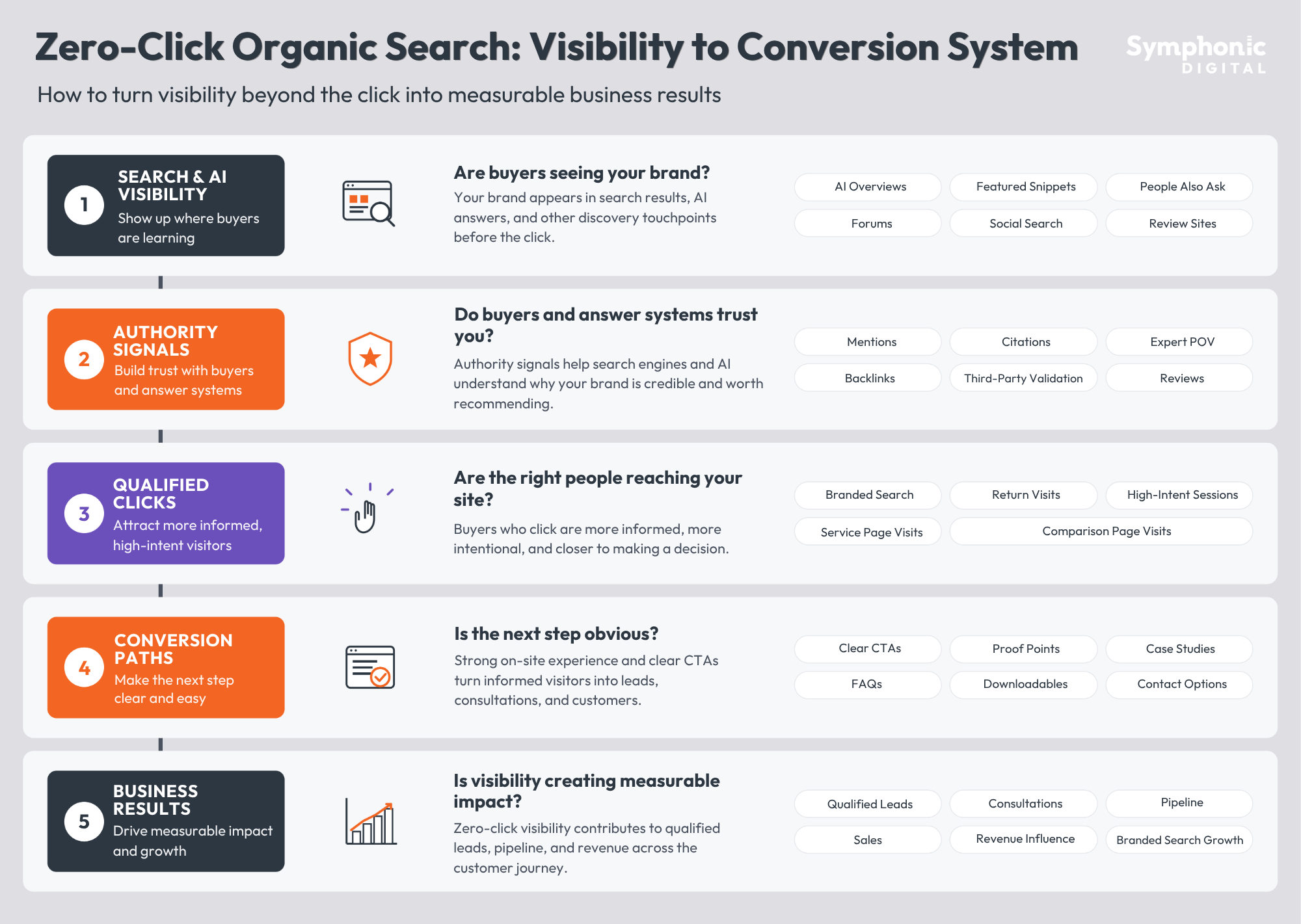
Turn Zero-Click Visibility Into a Conversion System
Zero-click strategy works best when visibility, authority, and conversion planning are connected. Marketers need to understand where the brand is showing up, strengthen the signals that establish credibility, and create clear paths for qualified visitors once they reach the site. This also ties into the three-stage AI buyer journey, where buyers move from discovery to validation to decision across multiple search and AI touchpoints.
Optimize for Share of Voice, Not Just Rankings
Rankings still matter, but they do not tell the whole story in a zero-click environment. Your brand can influence a buyer without earning the click, especially when it appears in AI-generated answers, featured snippets, comparison results, community discussions, social posts, review platforms, or trusted third-party content.
You can track share of voice across:
- Priority non-branded search terms
- AI Overviews and AI search tools
- Featured snippets
- People Also Ask results
- Comparison queries
- Industry listicles
- Third-party review sites
- Forums and community discussions
- YouTube and social search results
- Branded search results
This gives you a better view of whether your brand is part of the conversation and helps you spot visibility gaps that rankings alone may miss.
Use Link Strategy, Not Just Backlinks, to Build Authority
Zero-click search changes link strategy by making brand authority broader than traditional backlinks. Backlinks still matter, but mentions, citations, expert commentary, co-occurrence, and third-party validation can also influence how people and systems understand your brand.
A stronger link strategy can include:
- Earning links from credible industry publications
- Contributing expert commentary to relevant articles
- Building partner content around shared audience questions
- Improving visibility on trusted directories or review platforms
- Creating original research or data worth citing
- Strengthening internal links between blogs, guides, and service pages
- Updating older content so it reflects current search behavior
Internal links are especially important because they connect education to action. A good zero-click link strategy helps search engines understand your expertise and helps users move from research to decision.
Create Conversion Paths for More Educated Visitors
Zero-click visibility can send fewer visitors to your site, but those visitors may arrive with higher intent. Your website should be ready for people who have already read summaries, compared options, checked third-party sources, or seen your brand mentioned before they click.
Useful site updates include:
- Clear above-the-fold messaging
- CTAs tied to the visitor’s intent
- Short forms for high-intent actions
- Proof points near conversion points
- Case studies or results summaries
- FAQs that answer common objections
- Strong internal links from blogs to services
- Clear contact options for users who are ready to talk
The goal is not to push every visitor into the same CTA. The goal is to make the next step obvious based on intent, whether that is reading a related guide, comparing solutions, viewing a case study, or scheduling a consultation.
Measure What Actually Shows Business Impact
In a zero-click search environment, organic reporting needs to show more than traffic movement. Sessions, clicks, and rankings still matter, but they do not fully explain how visibility influences buyers before they reach your site. The goal is to measure whether organic visibility is creating stronger brand demand, better-qualified visitors, and more meaningful conversion activity.
Useful zero-click SEO metrics include:
- Share of voice: How often your brand appears for priority topics, questions, and comparison searches.
- AI search visibility: Whether your brand, content, or POV appears in AI Overviews, answer engines, or AI-assisted search results.
- Featured snippet and SERP feature ownership: Where your content is earning visibility directly on the results page.
- Branded search growth: Whether more users are searching for your brand after discovering it through other search experiences.
- Organic-assisted conversions: How organic content contributes to demos, consultations, sales, or form fills across the full journey.
- Conversion rate by landing page: Which pages turn organic visitors into actual leads or sales opportunities.
- Lead quality: Whether organic conversions are becoming qualified opportunities, not just form submissions.
- Pipeline or revenue influence: How organic visibility supports sales growth, even when the first interaction was not a website visit.
Traffic should still stay in the dashboard, but it needs more context. A page with fewer sessions and stronger conversions may be more valuable than a high-traffic post that never moves users closer to action.
How to Adapt to Zero-Click Search and Drive Results
Adapting to zero-click search starts with a simple shift: organic strategy has to support the full decision journey, not just the website visit. Your content should help search engines, AI systems, and buyers understand what your brand knows, where it can help, and why it is worth considering.
That means visibility, authority, measurement, and conversion planning need to work together. Show up where buyers are learning, make your expertise easy to understand, track performance beyond traffic, and make the next step clear when qualified visitors reach your site.
Zero-click search does not eliminate organic opportunity. It changes where that opportunity starts. With the right strategy, brands can turn search visibility into stronger authority, more qualified visitors, and clearer paths to conversion.
Need support adapting your organic strategy? Explore Symphonic Digital’s SEO services, GEO services, or contact us to start the conversation.



.png)