





Key takeaways
- AI Overviews now appear above the traditional links, so visibility starts inside the summary box, not the results below it.
- Searchers increasingly open with seven-word-plus queries, which makes specific long-tail coverage more valuable than broad topical breadth.
- Content earns citations by answering the question directly near the top, then expanding, rather than building toward the answer.
- Structure decides extractability. Clear headings, schema markup, concise definitions, and FAQ sections give AI systems discrete passages to pull.
- E-E-A-T still governs source selection, so named authorship, original data, and cited research carry more weight than word count.
For marketers and business owners, this evolution raises pressing questions: How to optimize for AI search? What does SEO for ChatGPT and SEO for AIO entail? In this article, we’ll explore how AI is transforming search behavior, unpack the implications for search strategies, and provide actionable insights to help you stay ahead in this rapidly evolving digital environment.
Understanding AI’s Role in Modern Search
Artificial intelligence (AI) is revolutionizing digital media, how users interact with search engines, and fundamentally altering the SEO landscape. Platforms like AI-Generated Overviews (AIO) and ChatGPT are at the forefront of this transformation, offering users a more conversational and research-driven approach to finding information. These tools excel at addressing informational and exploratory queries rather than transactional ones, marking a significant shift in user behavior and search intent.
What Are AIO and ChatGPT?
AI-Generated Overviews (AIO):
AIO refers to the summaries generated by AI models that synthesize data from multiple sources into concise, easy-to-read overviews. These overviews often appear in search results as part of search engine experiments or proprietary AI tools, providing users with instant answers to complex questions without requiring them to browse multiple pages.
AI Overviews are already becoming more and more prevalent. According to a recent Pew Research Center study, in just one month of searching, 60% of respondents hit a search engine results page with an AI-Generated Overview present. This shift means visibility now begins inside the overview box, not the ten blue links below it.

ChatGPT:
Developed by OpenAI, ChatGPT is a conversational AI model designed to engage users in natural, human-like dialogue. Unlike traditional search engines that rely on keyword matches, ChatGPT processes and understands queries contextually, making it particularly useful for research, brainstorming, or learning new topics. Users interact with the model directly, often bypassing traditional search entirely. Learn more about ChatGPT here.
ChatGPT has recently launched the ability for all users to use the “Search” function within the ChatGPT interface that provides links and resources similar to traditional search. Link to external sites are provided within the long-from response, at the end of the response and then a full listing can be opened on the right-hand side of the screen.

Shifting User Behavior in AI-Driven Search
One of the most notable changes driven by AI tools is how users approach search. Research and exploration now dominate the use cases for tools like AIO and ChatGPT. Instead of typing transactional terms like "buy running shoes" or "best local plumber," users are leveraging these platforms for informational queries such as:
- “What are the benefits of running barefoot?”
- “How to fix a leaking faucet without calling a plumber?”
- “What is the history of marathon running?”
These tools are empowering users to conduct deep research and gather insights without sifting through multiple websites, presenting a more efficient and user-centric alternative to traditional search.
We are also seeing a notable shift in how users frame their search queries, with a growing preference for “ultra-long tail” terms—queries consisting of seven or more words—right from the start of their research process. Traditionally, users would begin with broad, general queries and gradually refine their searches as they gathered more information. Now, empowered by AI tools like ChatGPT and AIO, users are skipping the general phase and jumping straight into highly specific, context-driven queries.
For example, instead of searching for “benefits of running,” users might start with “what are the advantages of barefoot running for marathon training?” This change reflects an expectation that AI tools can understand and process nuanced questions immediately, delivering precise and tailored answers without the need for iterative searches. For SEO, this means optimizing for highly specific, intent-driven long-tail keywords is more crucial than ever.
The Implications of AI Search for SEO
For businesses and marketers, this trend underscores the growing importance of creating content that addresses user intent beyond simple product searches. Optimizing for AI-driven platforms means focusing on:
- Crafting content that provides clear, authoritative answers.
- Addressing complex, research-oriented queries in a conversational tone.
- Leveraging structured data to make content more discoverable and comprehensible for AI tools.
We will explore more detailed strategies for optimizing search in AIO as well as ChatGPT in the following sections.
AIO and Google Search Strategy: Optimizing for AI-Driven Results
AI-Generated Overviews (AIO) the newest addition to the Search Results Page (SERP) and they are taking up large amounts of search real estate. AIO serves up concise summaries that are aimed at keeping users in Google’s search environment rather than clicking to deeper sites. AIOs have links to deeper sites and will feature brands, making it a constant topic of client conversations. The question, “How do we get featured in Google’s AI Overviews?” is top of mind and we are here to give some answers to that question - with a BIG caveat. We honestly don’t know what is going to be 100% effective in showing in AIO - it’s new, it’s changing and it’s unpredictable. However, there are trends we are seeing that can influence how you build an AIO SEO strategy.
To ensure your content stands out in this AI-driven environment, you must adapt your search engine optimization strategy to align with the needs of AIO systems. Here are the key elements of an effective AIO-focused SEO strategy:
1. Long-Form, Specific Content
AIO systems prioritize content that is detailed, topic-rich, and capable of answering user queries comprehensively. To meet these expectations:
- Write long-form articles that dive deeply into the subject matter.
- Use structured headings and subheadings (H1, H2, H3) to break down complex topics into manageable sections.
- Cover multiple facets of a topic to provide a one-stop resource that satisfies a range of user intents.
Example: Instead of creating a generic article on “The Benefits of Exercise,” craft a comprehensive guide titled “The Top 10 Benefits of Exercise for Mental Health and Physical Well-Being,” with sections on specific benefits, supported by actionable tips and scientific evidence.
2. Expert Insights and Authoritative Content
AI systems, including AIOs, are designed to surface content that demonstrates expertise, authority, and trustworthiness (E-E-A-T). Stand out by incorporating:
- Expert quotes and opinions: Collaborate with industry experts or cite credible sources to enhance the authority of your content.
- Actionable tips: Offer practical advice that users can implement immediately.
- Data and research: Use statistics and studies to back up your claims, such as:
"According to a study by HubSpot, long-form content generates 3x more backlinks than short articles."
Including such insights makes your content more attractive to AI-driven summarization processes.
3. Technical Crawlability and Optimization
A well-optimized website is essential for ensuring your content is discoverable and usable by AI systems. Focus on:
- Schema markup: Implement structured data to help search engines understand your content’s context and improve its chances of appearing in AI summaries.
- Meta Data optimization: Craft clear, keyword-rich meta titles and descriptions tailored to AIO systems.
- Mobile-friendly design: Ensure your site is fully responsive, meets Google’s Core Web Vitals standards for load speed, interactivity, and visual stability, and follows mobile optimization best practices.
These technical improvements not only enhance crawlability but also improve user experience, a key ranking factor.
4. Topic Clusters and Internal Linking
AIO systems excel at interpreting content hierarchies and relationships. To make your site more AI-friendly:
- Develop content hubs: Group related articles into topic clusters, with a central “pillar” page linking to more specific “cluster” pages.
- Strategic internal linking: Use internal links to guide both users and AI systems through your content, reinforcing its relevance and authority.
Example: If you have a pillar page on “Digital Marketing Trends,” link to related cluster pages like “AI in Digital Marketing” or “SEO Strategies for ChatGPT.”
SEO for ChatGPT with Bing Search Integration
With Bing Search now powering ChatGPT, SEO strategies must adapt to accommodate both Bing’s ranking signals and ChatGPT’s content processing capabilities. Bing’s algorithms differ from Google’s in key ways, particularly regarding keyword usage and content presentation, making it essential to tailor your approach to meet these requirements.
1. Keyword Density and Strategic Placement
Unlike Google, Bing places a stronger emphasis on keyword-rich content. While keyword stuffing should be avoided, intentional and strategic use of primary and secondary keywords is essential to rank well.
- Ensure primary keywords are included in headings, metadata, and body content.
- Repeat key phrases naturally to reinforce relevance without overloading the text.
Example: While Google favors a conversational tone, Bing-optimized content for a query like “best cloud computing solution” might repeat the phrase in headings (H2), introductory paragraphs, and meta descriptions for better alignment with Bing’s ranking signals.
2. Direct and Concise Answers
ChatGPT prioritizes content that delivers value immediately. To cater to this, structure your content to be scannable and easily digestible:
- Use FAQ sections to address common user queries.
- Incorporate bulleted lists and highlighted key points for quick takeaways.
- Begin sections with concise answers, followed by in-depth explanations for additional context.
Example: For the query “how to improve website speed,” include an initial bulleted list of actionable steps (e.g., “compress images, enable caching, reduce server response time”) before elaborating on each point.
3. Aligning with Search Intent Over Storytelling
While storytelling can engage readers, Bing’s algorithms prioritize content that directly aligns with user search intent. This means crafting content that is straightforward and focused on delivering relevant information rather than creative narratives.
- Use headings and subheadings to clearly signal the topic of each section.
- Avoid lengthy introductions and instead dive straight into the subject matter.
Example: Instead of starting an article on “cloud storage benefits” with an anecdote, lead with a statement like: “Cloud storage provides scalable, secure, and cost-effective data management solutions for businesses of all sizes.”
Creating a Balanced SEO Strategy in a Multifaceted Search Landscape
As users are diversifying their search behaviors we have to understand the complex task of managing traditional search engines like Google and Bing, AI-powered tools like AIO and ChatGPT, and even social media. A successful SEO strategy must expand outside of platform-specific optimization to meet diverse user intents and needs. Instead of focusing solely on tactics for individual tools, businesses should prioritize creating value-driven, intent-aligned content that resonates across channels.
A balanced SEO approach begins with understanding what users want to accomplish—whether it’s learning about a topic, solving a problem, or purchasing a product. For example, informational queries like “What is edge computing?” require detailed, educational content, while transactional queries such as “Buy edge computing software” demand clear product-focused pages.
Focusing on user intent ensures that content is effective no matter where it appears—whether in Google’s featured snippets, Bing’s search results, or ChatGPT summaries.
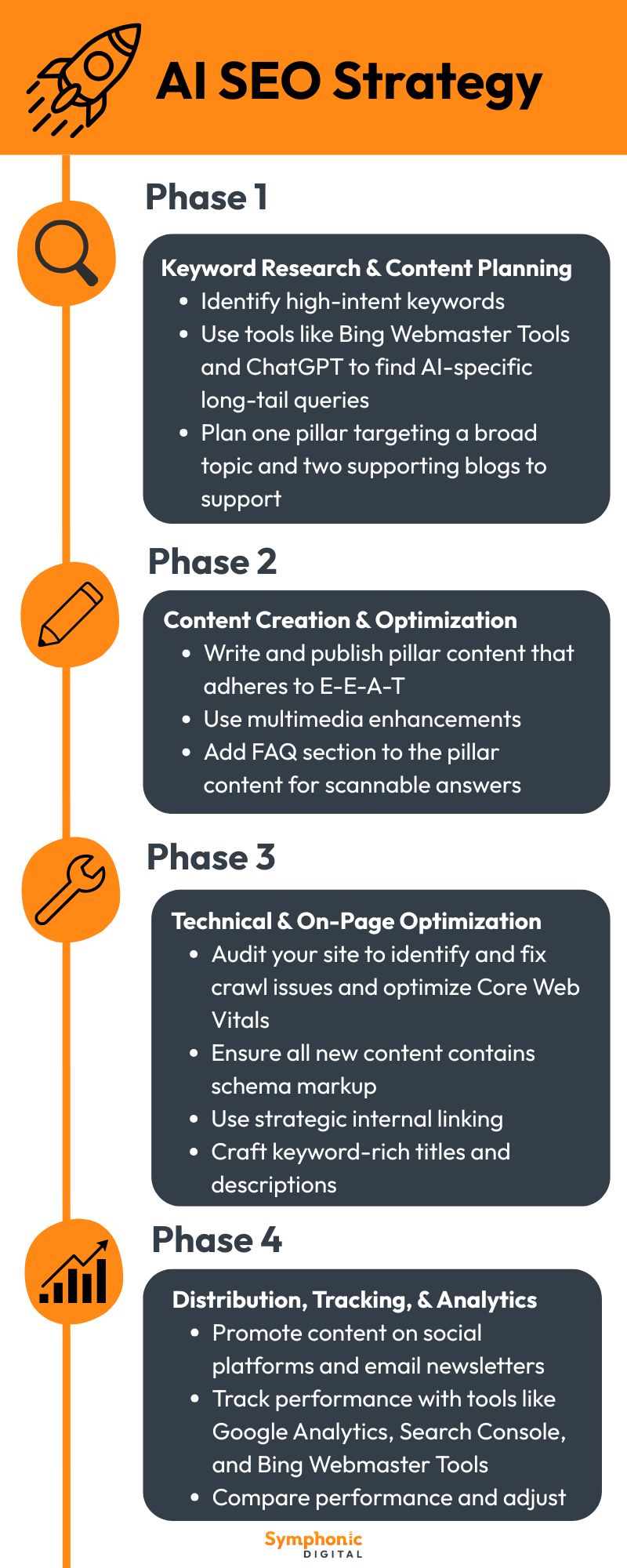
SEO Plan for a B2B Tech Website: AI SEO Strategy Example
A comprehensive monthly SEO plan integrates strategies to optimize content across multiple platforms while leveraging analytics tools to refine and improve performance.
Phase 1: Keyword Research and Content Planning
Keyword Research:
- Use tools like Google Keyword Planner, Bing Webmaster Tools, and ChatGPT for AI-specific long-tail queries.
- Identify high-intent keywords aligned with informational, navigational, and transactional queries.
- For example: “What is edge computing?” (informational) and “Best edge computing solution for healthcare” (transactional).
Content Mapping:
- Plan one pillar article targeting a broad topic (e.g., “The Ultimate Guide to Edge Computing for Enterprises”) and two supporting blogs addressing niche angles (e.g., “Top Use Cases for Edge Computing in Retail” and “How to Choose the Best Edge Computing Solution”).
Phase 2: Content Creation and Optimization
Content Creation:
- Write and publish pillar and cluster content, ensuring it adheres to:
- Google SEO: Long-form, well-structured articles with E-E-A-T (Expertise, Experience, Authority, Trustworthiness).
- Bing/ChatGPT Optimization: Keyword-rich headings and concise sections with direct answers.
- Multimedia enhancements like infographics and videos, optimized with relevant alt text and file names.
Content Optimization:
- Add an FAQ section to the pillar content for scannable answers.
- Cite authoritative sources or include expert quotes to enhance credibility.
Phase 3: Technical and On-Page Optimization
Technical SEO:
- Audit the site using Google Search Console and Bing Webmaster Tools to identify and fix crawl issues, broken links, or indexing problems.
- Ensure all new content includes schema markup to improve visibility for AIO and other AI tools.
- Optimize for Core Web Vitals (page speed, interactivity, and visual stability) for better performance on both Google and Bing.
On-Page SEO:
- Craft keyword-rich meta titles and descriptions tailored to both Google and Bing ranking signals.
- Use strategic internal linking from older, high-traffic articles to new content hubs, reinforcing topic authority.
Phase 4: Distribution, Tracking, and Analytics
Content Promotion:
- Share new content on LinkedIn to reach B2B audiences.
- Feature the pillar article in an email newsletter with actionable takeaways.
- Secure guest blogging opportunities to build backlinks.
Tracking Performance:
- Google Analytics: Monitor organic traffic, session duration, and conversion rates for content pages.
- Google Search Console: Track keyword rankings, impressions, and click-through rates to evaluate Google-specific success.
- Bing Webmaster Tools: Analyze performance on Bing, including page indexing and ranking insights.
- ChatGPT Impact: Evaluate changes in organic traffic and site engagement from AI-driven search sources.
Insights and Adjustments:
- Compare performance across Google and Bing to identify platform-specific strengths and weaknesses.
- Use insights to adjust the following month’s content strategy, such as doubling down on high-performing content topics or improving underperforming pages.
Future-Proofing Your SEO for AI Search
The rise of AI-generated search experiences—whether through ChatGPT, AI Overviews (AIO), or Bing’s evolving search integration—is transforming how users find information. Traditional SEO tactics alone are no longer enough. Businesses must adapt to AI-driven search behaviors by optimizing for long-tail queries, structured content, and authoritative insights.
While AI-powered search remains unpredictable, one thing is clear: creating value-driven, intent-focused content is the key to visibility in an AI-first world. By balancing strategies for Google, Bing, and AI-driven search tools, businesses can future-proof their SEO approach and ensure they remain discoverable, relevant, and competitive.
The future of search is AI-driven—are you ready to optimize for it? Ready to align your SEO strategy with AI-powered search? Contact our search engine optimization specialists today.






.png)






