



Key takeaways
- Claude embeds an invisible watermark in the text it generates. Readers cannot see it, and it does not change quality, meaning, or cost.
- The watermark carries no information about you, your company, or your conversations with Claude.
- A detected mark shows Claude was likely involved. It does not prove Claude wrote the content, and it cannot confirm a human did.
- This is not a Claude-only change. EU transparency obligations took effect August 2, 2026, and most major models have the same watermarks.
- No platform has made watermark detection a ranking signal. Content quality still decides performance, which is where the effort belongs.
Over the last couple of weeks, I've been seeing a barrage of posts and articles about THE Claude Watermark. Yes, Claude is now watermarking everything it writes. Invisible. Untraceable to you. But detectable, if you have the key.
My first reaction was concern. We use Claude SO much as marketers at this point, and the first concern is that we won't be able use this helpful tool anymore. My second reaction, after reading through it, was "okay, but does this actually matter?"
I don't think it does, at least not in the way everyone seems to be saying it will. But I do think there are a lot of people in the business world who don’t know this is happening and/or why it matters.
Related Content: Content Homogenization and Brand Voice SEO for AI Search SERP Volatility and SEO
What Anthropic Actually Did
On August 2, 2026, the transparency obligations in Article 50 of the EU AI Act became enforceable. It requires AI companies to mark content their systems generate so it can be identified later. Anthropic, along with roughly 190 other signatories, signed onto that Code of Practice in July. Non-compliance carries real impact to companies with fines up to €15 million or 3% of global annual turnover, whichever is higher.
So Anthropic built a watermark.
Here's the simple version of how it works, because the mechanism itself is honestly the most interesting part. When Claude writes a sentence, it's constantly making tiny word choices where either option is equally fine. For example, "overcast" or "grey" are basically synonymous and don’t change the sentence. But now, Anthropic uses a hidden key to control those flips instead of leaving them random. You'd never notice reading it; nothing looks different, nothing costs more, nothing runs slower. But with the key, they (crawlers, AI Agents, etc.) can check whether the pattern of word choices lines up, and estimate the odds Claude was involved.
A few key points to know:
- A watermark can't prove authorship. It can only estimate that Claude was "likely involved." It can not distinguish "Claude wrote this" from "Claude edited a sentence of this."
- Heavy editing most likely removes a large percentage of the watermark. Light edits probably don’t remove it at all. A full rewrite doesn't hold the watermark at all.
- It barely shows up on factual writing or code, because there's no "equally good" word choice for the model to work with in the first place. So if you’re saying something like “In 1776, the Declaration of Independence was adopted,” that is a fact and there isn’t a particular word choice that matters and/or could be watermarked.
- It applies globally, not just in the EU, because Anthropic doesn't yet have a reliable way to scope it by region.
Full detail is on Anthropic's site if you want to hear it right from the source: https://www.anthropic.com/news/claude-text-watermark.
Here's the Part Nobody's Talking About: Not Every Model Does This
This is the piece that's getting lost in all the Claude headlines, and I think it's actually the more useful thing to know. Watermarking is not universal; however, it’s being used in a hodgepodge way across the platforms.
- Gemini has been watermarking generated text since 2024 through SynthID. This isn't new for Google, Claude is the one catching up. Surprise!
- Claude just joined them, but only for models launched on or after August 2, 2026. Older models are getting it rolled out over the coming months.
- ChatGPT does not currently watermark text at all. OpenAI actually built a text watermarking system back in 2024, tested it, and chose not to release it . The removal was reportedly over concerns about how easily paraphrasing defeats it and the risk of unfairly flagging non-native English writers. OpenAI signed the same EU Code of Practice everyone else did and says it plans to expand its provenance work to text, but as of this writing, ChatGPT text carries no watermark.
- Grok (xAI) didn't sign the EU Code of Practice at all, and there is no public documentation of a text watermark in its output.
- Meta, Microsoft, and Mistral all signed the code too, but public documentation of a live text watermark from any of them is thin right now.
So if you draft something in Claude, it likely carries a mark. Draft the same thing in ChatGPT, and right now, it doesn't. That's a genuinely strange place for the industry to be. The "AI content" label depends less on whether AI was involved and more on which specific tool someone happened to open. Worth remembering next time someone talks about "AI-generated content" like it's one detectable category. It isn't, not yet.
Why This Feels Bigger Than It Is
The news coverage and LinkedIn backlash on this was - and is - everywhere. People are worried this is the start of AI content getting flagged, demoted, or publicly shamed. I get it but I also think this is an important step in fighting against AI spam content that runs rampant. With that being said, there are a few core things to note.
Google has not called it a ranking signal
Nobody, including Google, has said watermark detection is a ranking input. Google's public stance has been consistent since 2023: production method doesn't matter, quality does. That policy hasn't moved. If rankings shift, the cause is almost always somewhere else. Understanding what actually drives ranking movement is a better use of the worry.
The ranking data shows no penalty
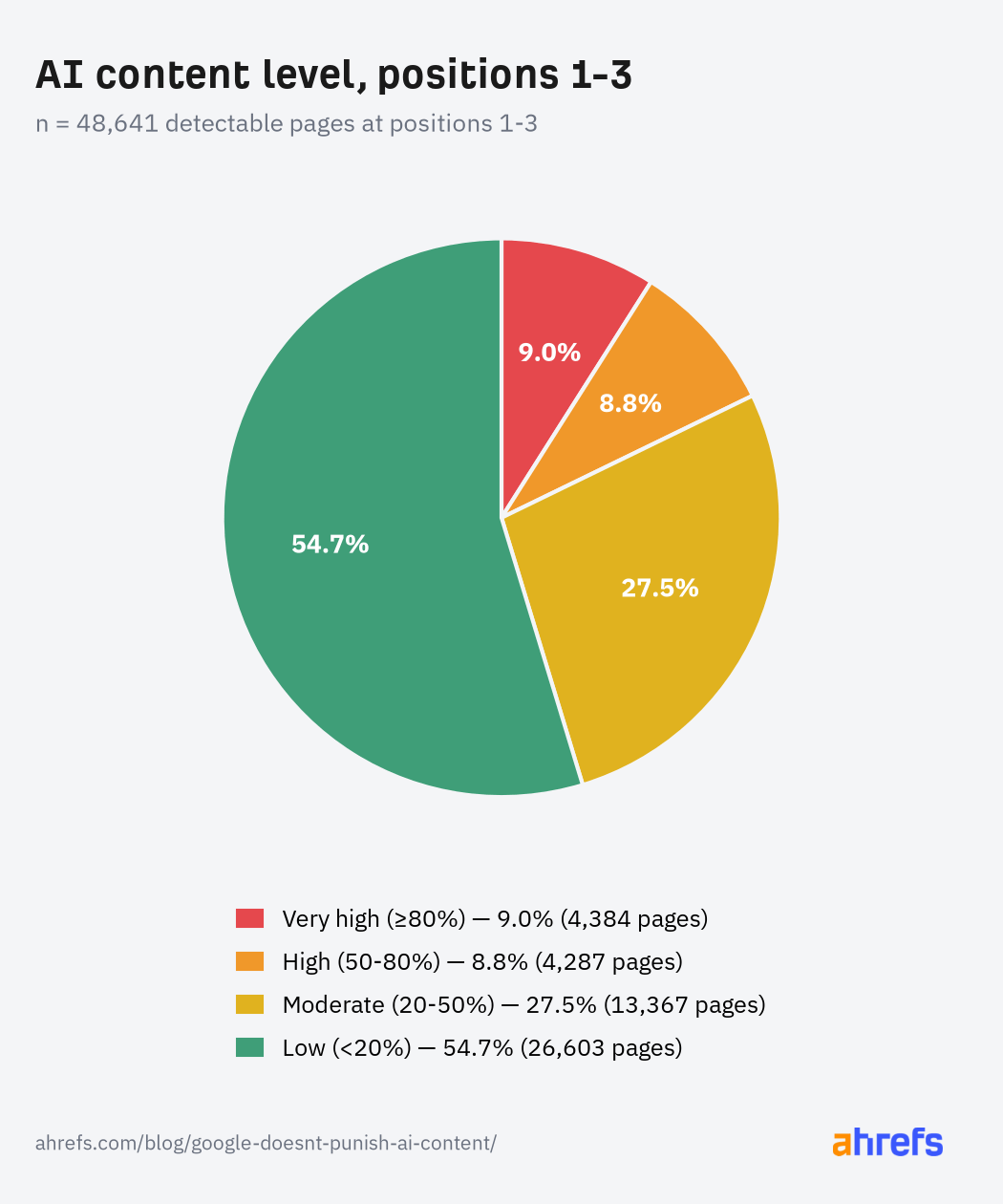
The data doesn't support the fear. An Ahrefs analysis of 1,000,000 pages found that 82% of high-ranking pages contain some form of AI-generated content, with no significant correlation between AI involvement and poor rankings. We see pages with low AI involvement doing best; however, that doesn’t mean that some AI is bad or harmful.
Most marketers already use AI
Depending on which survey you look at, somewhere between 85% and 94% of marketers now use AI somewhere in their content process. This isn't a fringe practice getting caught red-handed. It's the default workflow across the entire industry.
The Games People Are Already Playing: Why watermark removal tools don't work
Naturally, within days, people started looking for workarounds. The most common one: write with Claude, then run the draft through ChatGPT or Gemini to "clean it up," on the theory that this scrubs the watermark.
The problem here is that you aren’t removing the watermark, you’re just exchanging it for another. If you run Claude's output through Gemini, you don't end up with unmarked text. You end up with Gemini's watermark instead of Claude’s. The only way to end up with genuinely unmarked text is a human actually writing or fully rewriting it; not another model doing the rewriting for you.
There's also a small industry of "AI watermark remover" tools that have popped up recently, promising to strip the mark with a paste-and-go tool. Worth knowing what they can actually do: they're good at stripping hidden Unicode characters and file metadata, which is real but minor. The watermark itself lives in which words the model picked across the whole piece, not in any single deletable character, so the only method that reliably disrupts it is a heavy rewrite. Most of these tools even admit as much in their own fine print.
I bring this up because it's a good tell for where the real anxiety is coming from. People aren't trying to hide that AI helped; they're trying to avoid being flagged or punished for it. But flagging isn't the same as penalizing, and right now, nothing suggests a flag is costing anyone rankings or reach. The effort going into “finding” a watermark is effort that could go into making content better instead.
What Actually Moves the Needle
Here's where I'll push back on my own industry a little. The anxiety about watermarks is, I think, a distraction from the thing that's always mattered: is the content any good?
In my experience, content built with AI-assisted drafting and real human editorial oversight performs better than fully automated output. This is because AI and humans value human judgment, original data, a real point of view, or lived experience the model couldn't invent on its own.
This is the sameness problem underneath the watermark panic. Content homogenization is what happens when everyone optimizes toward the same output, and it costs trust long before it costs rankings.
So here's what I'd actually do with this news, in order:
- Don't panic about the watermark. It's not something that is harming you today. Just keep making good content with good value.
- Use AI as a drafting tool, not a final writer. Outlines, first passes, research synthesis is perfect. Don’t just take whatever an LLM gives you and publish it without edits or rewrites.
- Add what the model can't. Client data, a contrarian take, a story from an actual project that went sideways and what you learned. That's the stuff that both ranks and reads like it came from a person. Structuring it so an AI system can quote you is the other half of the job, which I've written about in SEO for AI search.
- Disclose when it protects you, not because you're forced to. If a client or exec is publishing under their own name, a short factual note about how AI was used builds trust rather than pretending you’re not using AI at all (which we all know isn’t true anyway).
What You Need to Know and Communicate
The watermark is real, it's here, and it's not going away. But it was never going to be the thing that decided whether your content is successful. Focus on original thinking, real expertise, a point of view nobody else has.




.png)