




Key takeaways
- The interface is incredibly simple. It’s closer to early LinkedIn Ads than modern Google Ads. Easy to learn, but light on reporting and visibility.
- You're flying partially blind. No keyword data, no audience insights. You see impressions, clicks, conversions, spend, CTR, CPC, and CPM, and that's it.
- You can track conversions but couldn't bid to them during our test. Objectives were limited to Reach or Clicks, with "Conversions" showing as coming soon. That was the single biggest constraint for lead gen at the time. (Heads up: OpenAI has reportedly begun rolling out cost-per-action bidding and conversion-optimized campaigns to select accounts since late May 2026. Check whether it's live in yours.)
- Bids start low and climb fast. We were told $3 was a "strong" bid. We ended up around $12 to pace properly, landing at a ~$9 average CPC.
- The auction is already crowded. Nearly every test search we ran surfaced a competing agency ad. The secret is out.
- Treat your intitial small spend as a smoke test, not a real test. It's enough to learn the mechanics. It is not enough to judge the channel on lead volume.
Most of what's been written about ChatGPT advertising and how it’s reshaping search is a reaction to a press release. Big revenue numbers, "the window is closing," move-early-or-lose framing. Useful context, but none of it tells you what happens when you actually open the account, fund a campaign, and try to generate a B2B lead.
So we did that. We put our own money through the OpenAI Ads Manager Beta over one month, targeting agencies that need white-label PPC, SEO, and paid search fulfillment. This is what we learned about setup, reporting, bidding, and what it actually takes to move someone to a lead in a conversational environment.
What You Need Before You Can Launch a ChatGPT Ad Campaign
This is the part the news coverage skips, and it's where you'll lose the most time.
To create your first campaign you have to provide your business name, logo, and credit card. If you plan to send traffic to a domain different from the one tied to the account, you'll also have to verify the business, which requires your EIN (Employer Identification Number). Plan for the wait: business verification typically takes a few business days, and individual ad review after that usually clears within about 24 hours.
A few friction points worth knowing up front:
- You can't save a draft while the business review is pending. Close the tab and you start over. Build it when you can leave the tab open, or expect to redo your work.
- There's no duplicate function. You can't copy a campaign, ad group, or ad. Every one is built from scratch, which is a real time drain once you're spinning up variations.
- The workaround: skip the guided UI and use bulk upload (CSV) instead. The template follows the same Campaign → Ad Group → Ad hierarchy, so you can copy and tweak rows in a spreadsheet and define many ad groups and ads in one file. It's the closest thing to a duplicate function the platform offers.
Here's what's actually available at each level today:
Conversions are listed as coming soon at the campaign-objective level. But you can still set up conversion events for measurement. Ours used a simple event call dropped in through Google Tag Manager, exactly like any other publisher tag. You just can't optimize toward it yet.
What the Reporting Shows (and Hides)
You get campaigns, ad groups, and ads, each with: impressions, clicks, conversions, spend, CTR, average CPC, average CPM, and your destination URL. The overview also breaks out device and country (our spend was overwhelmingly mobile, and we only targeted the U.S.).
What you don't get is the data most PPC managers depend on:
- No keyword or query data. You never see what someone typed to trigger your ad.
- No audience insights. You don't know who showed up.
- No way to bid to a conversion. Only Reach or Clicks.
If something works, you'll know it worked — you just won't know why. The only real lever you have over relevance is the context-hint prompt you write for each ad group, plus your landing page and ad copy. OpenAI's own support confirmed as much: context hints "guide matching but aren't exact-match keywords and don't guarantee delivery."
The workaround: lean hard on UTM parameters and GA4. Even though the platform can't optimize to your lead event, UTMs let you see which campaigns and ad groups drive better on-site behavior. Tag everything before you launch with utm_source=chatgpt because retroactive attribution is impossible.
We also installed Microsoft Clarity (free) for session recordings and heatmaps. It confirmed our "Schedule Consultation" form was correctly in place on the landing page, showed the fast-bounce behavior that's typical of B2B cold traffic, and — notably — flagged at least three bot sessions in our small sample. Bots are an industry-wide problem, so that wasn't shocking, but it's worth watching at this scale.

What ChatGPT Ads Actually Cost (Spoiler: not $3)
At launch, the platform gives you a forecast telling you whether your bid is strong. Ours said $3 was good. Then we got zero impressions.
Here's how our bid actually climbed over the month:
That $12 max bid produced an average CPC of roughly $9, about 3x where we started. For context, that's actually in line with many of our other client CPCs, so it's not off-market. But plan for it: your real entry bid is much higher than the forecast suggests, and you should expect to nudge bids up daily early on.
We originally set a $50/day budget. It took about a week and a half of $1 daily bid increases, plus adding a third ad group, before we could actually spend it.
Our Three Ad Groups, and the Result That Surprised Us
We started with two ad groups so we could compare intent levels using the same ad (to keep the test clean):
- High intent: context hint aimed at agency leaders actively choosing a white-label vendor or comparing white-label PPC vs. building in-house.
- Consideration: aimed at founders, ops directors, and PMs hitting capacity constraints and exploring how to fulfill client PPC/SEO work.
Neither alone could pace the budget at a reasonable bid, so we added a third:
- Broad: creative/brand/PR agencies with a client suddenly asking for ad campaigns. This one ran the highest CPCs, predictably, because of the loose targeting.
The surprise: in GA4, the consideration group drove the most on-site engagement of any group, followed by high intent, then broad. Stranger still, the high-intent group converted at roughly half the rate of consideration — even though it was the more precisely targeted of the two.
Early read: in a conversational environment, the "I'm still figuring this out" mindset may be more receptive to a new vendor than the "I've already shortlisted" mindset. We'd want more data before betting on that, but it's a useful flag.
The Tracking Gap: 53 Clicks vs. 35 Sessions
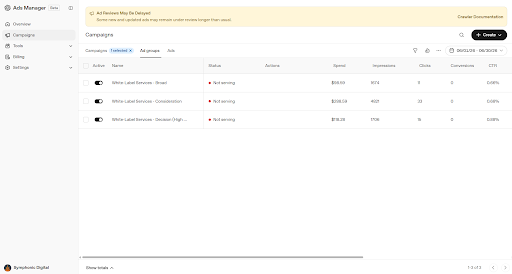
The platform reported 53 clicks. GA4 recorded 35 sessions. Some drop-off is normal everywhere: cookie-banner declines, tracking gaps, fast bounces. But roughly 34% is on the high end, suggesting more leakage than we typically see from Google, LinkedIn, or Meta in B2B. Budget for the idea that your analytics platform will show fewer clicks than OpenAI bills you for, and reconcile the two before you trust either in isolation.
One pattern other advertisers keep flagging is worth bracing for: a lot of ChatGPT-driven traffic lands in analytics as "direct" rather than referral or paid. If you don't hard-tag every URL with UTMs before launch (utm_source=chatgpt, utm_medium=cpc), you'll undercount the channel and conclude it failed when it didn't. This is the cheapest, highest-leverage thing you can get right on day one.
Our Conversion Result: One Click, Zero Leads
We set up a "Schedule Consultation" lead event. Over the month, exactly one person clicked it and never finished the form. Interest, not a lead.
The amount we spent is usually enough to land at least one conversion, so call this a partial success: the funnel worked, the intent was there, the finish line wasn't crossed. The lesson is structural, not creative. With only Reach and Clicks to bid to, the system can't learn its way toward your best prospects. So you need a proxy event, something lighter than a form completion that signals quality, like an engaged visitor who scrolls or interacts on the landing page. The platform still can't optimize to it, but it gives your UTM/GA4 analysis a much better quality signal than "clicked vs. bounced."
Important update since our test: OpenAI has reportedly switched on cost-per-action bidding for select advertisers and begun rolling out conversion-optimized campaigns, with early access tied to accounts that had conversions configured through the pixel or Conversions API. If that's reached your account, the calculus changes — it's the single most important development for performance-minded advertisers, because it's what makes the channel measurable against pipeline rather than just impressions and clicks. Configure your conversion tracking now so you're eligible as it expands.
About the Landing Page We Sent Traffic To
One thing we did right: we did not point ChatGPT traffic at our homepage. We built a dedicated, unlisted landing page specifically for the agency audience: white-label positioning, relevant case studies, social proof from other agencies, and a clear "Schedule Consultation" call to action.
We're intentionally not publishing the URL. It's set to no-index and tied to a live campaign; sharing it would expose the funnel to competitors and pollute the campaign data we're trying to keep clean. The takeaway here is the practice, not the page.
Why this matters more on ChatGPT than elsewhere: a visitor arrives from a narrow, specific conversation ("how do I white-label paid search?") and dropping them on a generic homepage creates a jarring context break. That break stings more here than on other channels precisely because their intent was so specific. A purpose-built page that mirrors the conversation is close to table stakes.
Even our dedicated page is fairly long and credentials-heavy. That builds trust, but for someone who came from a single tightly-scoped question, a tighter variant that restates the exact problem and offers one obvious next step may convert better. That's on the test list for round two.
Organic vs. Paid in ChatGPT: the CTR Question, Answered Honestly
A fair question: how does clicking a ChatGPT ad compare to clicking through from ChatGPT's organic answer?
The honest answer is that there's no clean head-to-head number. The reason is the most important thing to understand about this channel. ChatGPT's organic answers rarely produce a click-out at all. Users read the synthesized answer and keep the conversation going rather than leaving for a website. Industry data backs this up: ChatGPT's overall click-through rate runs roughly 96% lower than Google's, and its share of referral traffic to websites is a sliver of Google's (on the order of roughly 0.2% vs. ~40%). Google sends roughly 190 times the more traffic to sites.
On the paid side, where the click-through dynamic is different, early benchmarks are coming into focus:

The takeaway isn't "ChatGPT ads are weak." It's that CTR is the wrong scoreboard here. A click out of a ChatGPT conversation is a deliberate interruption of what the user came to do, which makes it rarer and higher-intent than a search click. Optimizing for raw CTR pushes you toward baity copy and unqualified clicks. The number that matters is cost per qualified outcome, measured through your pixel, conversions setup, UTMs, and CRM, not the click rate the dashboard hands you.
Where ChatGPT Ads Deliver, and Where They Don't
One month in, here's what worked and what frustrated us from this test.
What Worked Well:
- Intent quality: Users arrive deep in a specific, narrowed-down conversation. The traffic that does click tends to be further along than cold display or social.
- Low learning curve: You can launch in an afternoon once verification clears.
- Early-mover pricing: CPCs are climbing, but competition is still thinner than it will be in a year. The creative and targeting know-how you build now(the same skills that separate winners in AI-driven paid search more broadly) compounds.
What Frustrated Us:
- Thin reporting: No keyword/query data, no audience insight. You optimize half-blind.
- Bids and CPCs that climb fast: The forecast undersells what you'll actually pay.
- Limited objectives during our test (Reach/Clicks only), though that's changing.
- Higher tracking leakage than established platforms (our 53 vs. 35 gap).
- No real support for smaller advertisers yet.
- A crowded auction in popular B2B niches — multiple active advertisers appearing on nearly every query and page refresh.
A Few Other Things Worth Knowing
Ad Copy Gets Truncated on Mobile
The Ads Manager UI warns that long ads get cut off, and our results confirmed it. Descriptions truncated, especially on mobile, which is where most of our spend went. Whatever your strongest hook is, get it in the first few words.
What OpenAI Support Actually Offers
We reached out to OpenAI support for tips. The reply was polite and informative but made clear there's no one-on-one onboarding or dedicated agency support right now. You follow the standard application and onboarding flow. The useful bits they did share lined up with what we found: keep ad groups themed around one clear intent, run several distinct ad variations, make titles and copy benefit-focused, link to the most relevant page, and add tracking parameters to destination URLs.
If you're used to Google Ads chat/email support, calibrate your expectations. This is a beta.
ChatGPT Ads: a Lead Gen Tool or Awareness Play?
We don't know yet, and anyone who claims certainty is guessing. What we can say: the plumbing works (events fire, UTMs pass, traffic is real), the intent quality looks promising, and the reporting is too thin and the conversion controls too immature to run this as a pure performance channel today. Right now it behaves like a high-intent awareness-to-consideration channel with lead-gen upside, best measured on downstream outcomes, not dashboard clicks.
One useful framing: treat it less like a normal paid channel and more like dark social or influencer traffic. Real, valuable, and partially untrackable, where some of the impact shows up as "direct" conversions you have to infer rather than count.
The mechanics will mature fast. Conversion bidding has already started rolling out, and CRM connectors and richer ad formats are clearly next. The flip side of that maturation is rising cost: advertisers are already watching their early-mover discount shrink as competitors flood in. The advertisers who learn the conversational creative game now, while CPCs are climbing but competition is still relatively thin, will have a real head start when it does.
We're running round two with a bigger budget and a sharper strategy. We covered what we'd do differently next time in our ChatGPT advertising playbook. We'll report back on the results.
Emerging channels like ChatGPT ads reward teams that can test, measure, and adjust in real time. That's the work our paid media team does every day, across paid search, programmatic, native, and now conversational AI. If you're thinking through where these channels fit into your paid strategy, let's talk.
ChatGPT Advertising FAQs
Can you bid to conversions in OpenAI's Ads Manager?
Not yet. Objectives are limited to Reach and Clicks; "Conversions" is marked coming soon. You can still set up conversion events for measurement. You just can't optimize delivery toward them.
How much does it cost to advertise on ChatGPT?
There's effectively no minimum to start in the beta, but bids climb quickly. We were told $3 was strong, got no impressions, and ended around a $12 max bid for a roughly $9 average CPC. Treat $500 as a learning budget; a real B2B test is several thousand per month over 60–90 days.
Who sees ChatGPT ads?
Logged-in adult users on the free and lower-tier ("Go") plans. Higher paid tiers don't see ads. That meaningfully limits the addressable audience, so don't expect search-scale volume.
What targeting options are available for ChatGPT ads?
Context hints, descriptive phrases about the conversations you want to appear in, plus your landing page and ad copy as matching signals. No keywords, no audience demographics, and no query-level reporting.
Why is my analytics showing fewer clicks than OpenAI?
Some drop-off is normal, but we saw a wider gap than usual (53 platform clicks vs. 35 GA4 sessions). Reconcile platform and analytics data before trusting either, and tag everything with UTMs before launch.
Is ChatGPT advertising better for B2B or B2C?
It varies more than almost any other channel. The product-link format looks built for B2C e-commerce, but those brands already have strong converting channels (Google Shopping, Amazon), so the early edge may actually favor niche B2B and considered-purchase categories where buyers use ChatGPT to research and shortlist. B2C feedback loops are faster (30–45 days); B2B needs a longer measurement window aligned to the sales cycle. Don't apply one segment's benchmarks to the other, or to your vertical, until you've tested it.

.png)


.png)






