





Key takeaways
- Ecommerce is shifting. We are seeing buyers researching, comparing and determining what to buy in AI search before ever visiting a website.
- Measurement is evolving with Peec AI's new Shopping Analytics tool, launched June 17, 2026, to see how individual products surface inside ChatGPT.
- The tool tracks visibility, win rate, position, mentioned price, competing brands, top queries, and product attributes at the SKU level, and the data ties back to fundamentals we already know how to optimize.
- For us, the value isn't the tool itself. It's what the tool lets us prove: which levers actually move visibility in a channel that used to be a black box.
Ecommerce is always evolving, bringing new ways to discover, sell, and advertise. We’ve navigated shifts from Google to TikTok, and now, AI chat is reshaping the landscape once again. Historically, users discovered products through search or social media before landing on a site or marketplace; a path that was always measurable.
Now, that funnel is collapsing into a single chat window. A shopper describes what they want in a sentence or two, and the model instantly returns a curated list of products with prices, ratings, and purchase links. Beyond speed, these recommendations are hyper-targeted and relevant, accounting for the user's preferences and chat history. With discovery, comparison, and consideration happening in one exchange, this is one of the most impactful shifts in consumer behavior. And it’s moving faster than most brands are prepared for.
This shift in behavior creates a real measurement gap. Ecommerce brands can see their Google rankings, their paid campaigns, and their on-site behavior. What they can't see is which products ChatGPT is naming, in what order, or where the model is sending shoppers next. That blind spot is exactly where we've been focused, and it's why we're paying close attention to what's coming next in this space.
We already use Peec.ai to evaluate AI brand performance and competitive AI shifts for our clients, and we are so excited about their new launch to address ecommerce visibility. On June 17, Peec launched Shopping Analytics, an SKU-level tracker for how individual products appear in ChatGPT shopping answers.
Before we get into how we're putting it to work for clients, it's worth zooming out on why this moment matters.
The bigger shift ecommerce needs to plan for
Shoppers are already using AI at both ends of the funnel, and Peec's research puts numbers to it: close to half of shoppers now start their product research inside an AI chat, and roughly two out of three use it during the comparison stage to weigh brands, models, and prices against each other. Neither number is reflected in the analytics dashboards ecommerce teams check every day, which means most brands are already behind on a channel their shoppers are actively using. We expect that gap to widen before it narrows, as AI surfaces multiply and shopping behavior keeps migrating toward them.
This is the environment Shopping Analytics was built for. Most AI visibility tools measure brand mentions or citations in a general sense, which is useful but incomplete. Shopping Analytics goes SKU by SKU: which specific products get named, which competitors show up alongside them, and what the model is saying about each one. That's the difference between knowing your brand shows up in AI answers and knowing whether the products you actually sell are the ones being recommended. Here's what it tracks, and then how we're using it.
What Shopping Analytics actually tracks
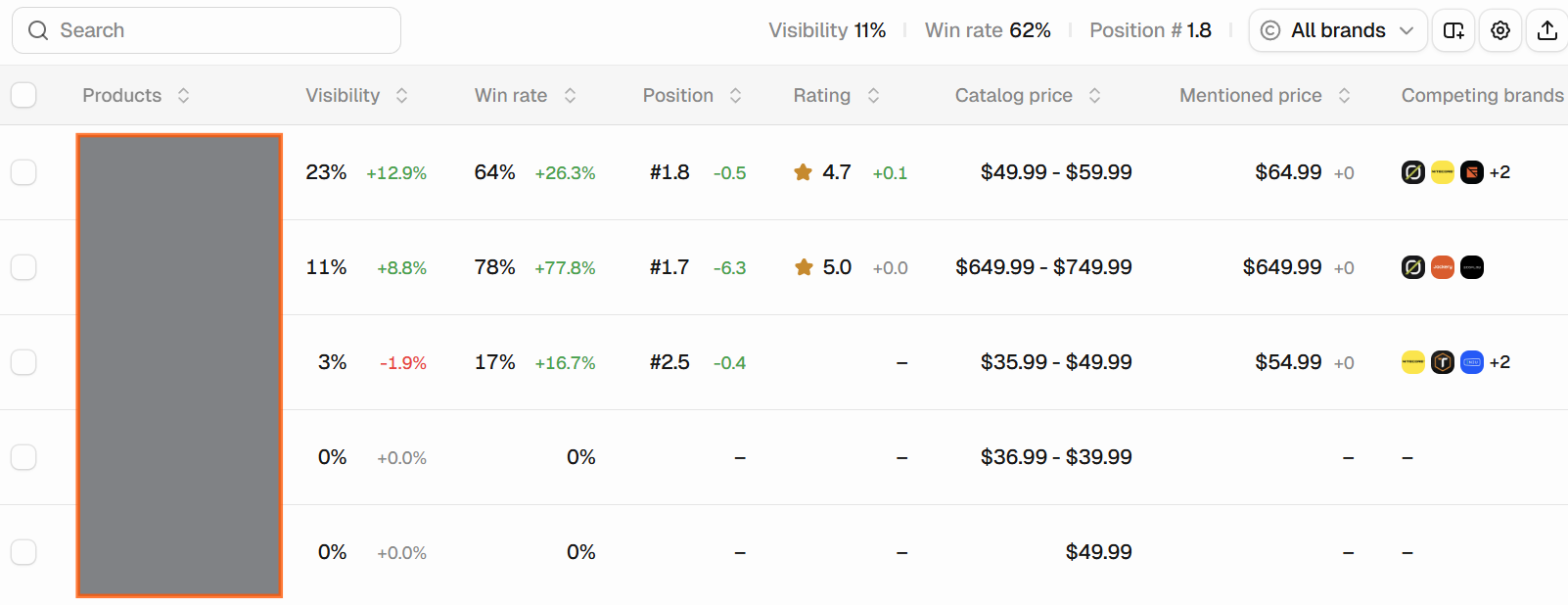
Every product in your catalog gets its own row and a set of metrics that describe how it's performing inside ChatGPT shopping answers:
- Visibility: How frequently your product turns up across the shopping prompts you're tracking, expressed as a percentage.
- Win Rate: How often ChatGPT places your product at the top of its recommendation list for a given prompt. This one is new and worth watching closely, since the top slot tends to earn the click.
- Position: The average slot your product lands in when it does surface in a chat.
- Appearances: A raw count of every time your product shows up across the prompts being tracked, useful for spotting volume shifts month over month.
- Mentioned price: The dollar figure ChatGPT is quoting for your product, which you can compare against what you're actually charging on your PDP.
- Competing brands: The other brands and products the model is putting next to yours in the same shopping answer.
- Top shopping queries: The specific prompts sending traffic to your product, including the fan-out queries ChatGPT generates behind the scenes to expand a shopper's original question.
- Attributes: The product characteristics ChatGPT leans on when it's comparing options in your category, ordered by how often each one factors into an answer.
Attributes are worth spending an extra minute on. Peec sorts them into three types: characteristics (things like "whey isolate" or "waterproof"), facts (true/false statements like "vegan" or "ships free"), and ratings (converts star reviews into a comparison score running from -4 to +4).
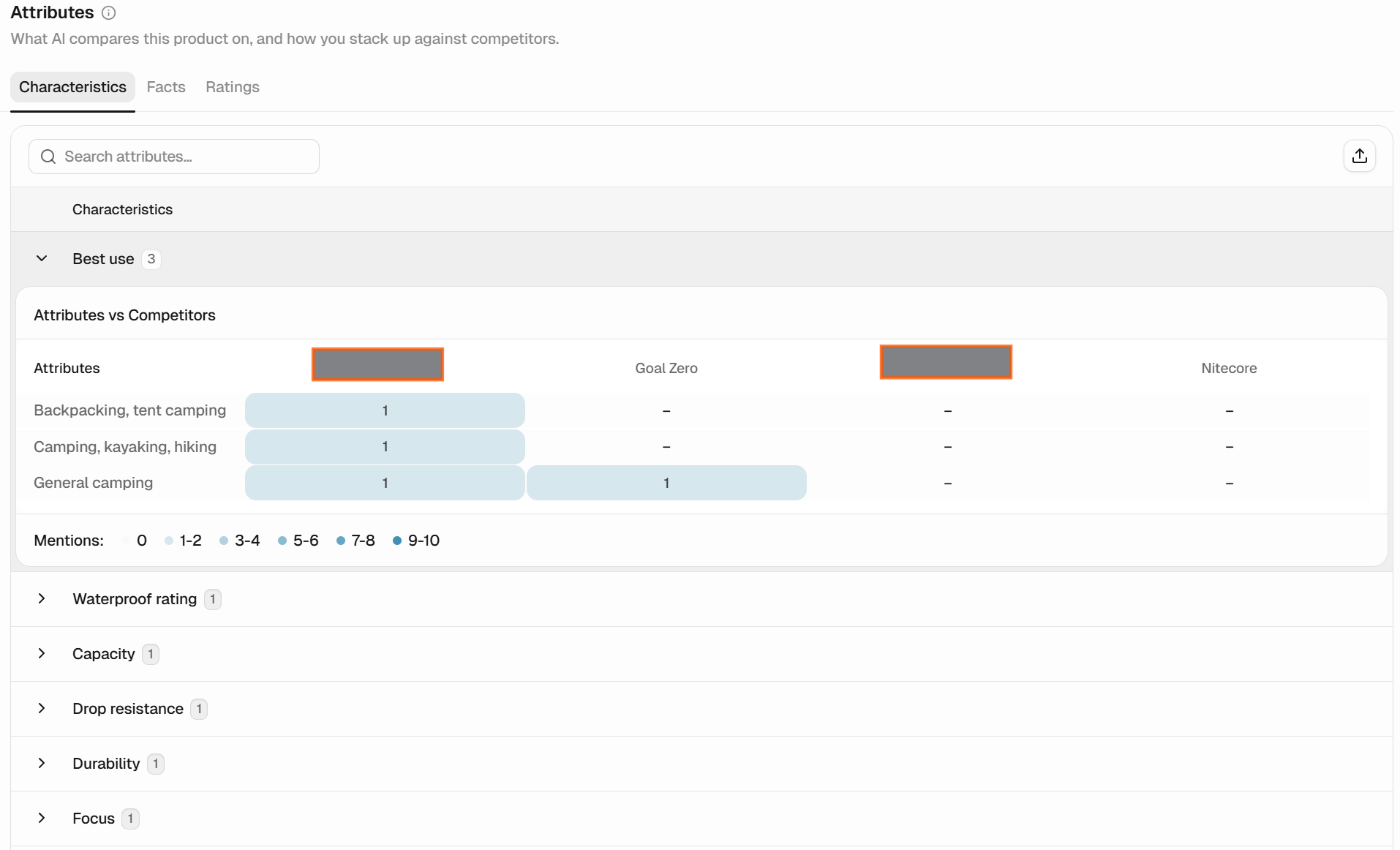
For our team, the characteristics view is where the most actionable insights sit. It surfaces the specifics we need to make sure are stated clearly on the PDP and in the product feed so ChatGPT has unambiguous signals to work with when it's building its answer.
Click into a product and you get more granular detail: where the model sends buyers after recommending the product, whether that's your own site, a third-party marketplace, or a retail partner, and where your product page copy falls short of the attributes AI is actually weighing.
The Google Shopping connection
Alongside the tool, Peec published research on how ChatGPT shopping works under the hood. The short version: ChatGPT shopping pulls product data from organic Google Shopping in real time. Peec's testing suggests that roughly the top 40 organic Google Shopping listings account for most of what ends up in a ChatGPT shopping answer, with an additional re-ranking layer on top.
The practical implication reinforces the point we'd make to any client thinking about the future of AI shopping: this isn't an entirely new discipline. Google Shopping optimization carries directly into ChatGPT shopping, so product feed quality, PDP structure, and merchant reviews now matter twice.
Peec also found that ChatGPT added brand names to its fan-out queries about 13% of the time, even on prompts where the shopper hadn't mentioned any brand at all. Even category-level shopping questions are getting shaped by brand recognition inside the model, which puts a premium on being described consistently across the web.
How to set up your product catalog in Peec AI
There are three ways to bring a brand's catalog in:
- Shopify: Paste your storefront URL and Peec pulls your catalog straight from the public product feed. This is the option we used, and it took about 10 minutes.
- CSV upload: Export your catalog as a flat file in Peec's format. Best for non-Shopify stores.
- Google Merchant Center: Connect the existing product feed you already maintain for Google Shopping.
Once the catalog was in, we sorted products into groups so we could track visibility patterns at the category level rather than one SKU at a time. That grouping is what makes the data useful at scale. A catalog of a few hundred products is impossible to review individually, and grouping lets us spot which parts of the catalog are winning or losing visibility so we know where to focus.
How we're thinking about this for clients
Our view is that AI shopping strategy has to start from real signal, not intuition, and this data is the closest thing we've found to real signal at the product level. For ecommerce clients, that means three things traditional analytics can't give us: a clear read on how their brand is being described inside AI shopping answers, in the model's own framing; a full view of the competitors ChatGPT is putting next to them, which is often a different set than the one they've been benchmarking against externally; and a ranked list of the product attributes actually influencing recommendations in their category. Together, that's what lets us build an AI shopping strategy instead of guessing at one.
A few of the ways this is already showing up in our work:
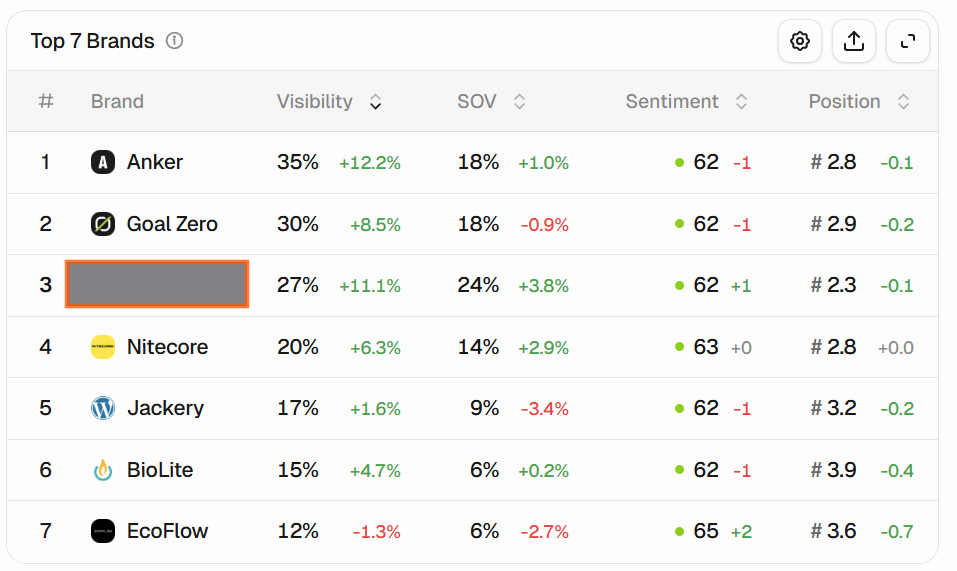
- Benchmark against the competitors ChatGPT actually surfaces: The brands showing up next to a client's products in shopping answers often differ from the competitor set they've been tracking. That gives us a truer read on who they're competing against in the model, not just in traditional search.
- Diagnose perception gaps in product page copy: When the model is weighing attributes like "durable" or "certified organic" heavily in a category and a client's PDP doesn't state those claims clearly, we know exactly where the copy needs work.
- Reverse-engineer the wins: For the products already surfacing well, we can pull the specific prompts driving those placements and the content patterns behind them, then apply the same patterns to underperforming SKUs in the catalog.
- Catch declines before they compound: Monthly SKU-level gainers and losers surface problems while they're still small and localized, before they spread to adjacent products or categories.
- Pair fan-out data with Google Shopping and organic SEO work: Since ChatGPT shopping pulls from Google Shopping, the same optimizations strengthen both surfaces at once, which lets us stretch client budgets across two channels instead of one.
The measurement layer has been the missing piece since ChatGPT rolled out shopping features, and most ecommerce teams have been guessing in its absence. Per-SKU data changes that. It turns our recommendations from intuition into ranked priorities backed by numbers, which is where we believe every AI shopping strategy should start, and where the ecommerce brands who win this next phase will have started too.
What comes next for AI shopping
We opened this piece talking about a new front door for ecommerce, and it's worth restating: AI shopping isn't a future problem, it's a current one, and it's compounding fast. Peec has already flagged Google's AI Mode and Amazon's Rufus as the next surfaces to get this kind of treatment, and we expect the list to keep growing from there. Every one of those surfaces will need its own measurement approach, and brands that build that muscle now, on the surfaces available today, will be far better positioned when the next one arrives. That's the real opportunity in tools like Shopping Analytics: not just visibility into where things stand today, but a head start on how to think about what's coming.
If you're thinking through what this shift means for your catalog, contact our team or explore our approach to generative engine optimization.



.png)






